Free 14-Day Access ON TELEGRAM

Part 5: Elliott Wave Extensions and Truncations Explained
Not all impulse waves carry the same weight. Some unfold in a relatively balanced way, while others accelerate dramatically or fail to complete as expected. Elliott Wave describes these behaviours through extensions and truncations. Understanding where momentum concentrates — and where it disappears — helps traders recognise when a trend is strengthening and when it is nearing exhaustion.
What Is an Elliott Wave Extension?
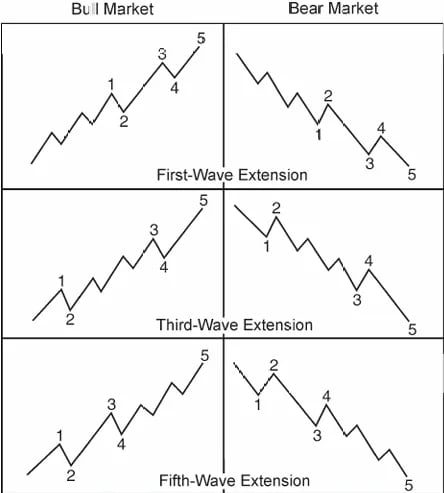
An extension occurs when one of the motive waves within an impulse becomes disproportionately large compared to the others. Instead of all three motive waves (1, 3, and 5) sharing the workload, one wave dominates the move.
Extensions reflect surging participation and momentum, where price travels farther and faster than typical proportional relationships would suggest.
Only one motive wave normally extends within an impulse.
The Three Possible Extension Types
Extensions can occur in wave 1, wave 3, or wave 5. Each carries different implications for structure and expectation.
Wave 3 Extensions: Sustained Trend Strength
Wave 3 extensions are the most frequently observed, particularly in liquid markets such as equities and forex.
When wave 3 extends:
It becomes the defining feature of the impulse
Momentum remains persistent rather than explosive
Wave 5 often resolves with a length similar to wave 1
These conditions typically indicate a trend that is healthy and broadly supported, rather than speculative or exhausted.
Wave 5 Extensions: Final Acceleration
Fifth-wave extensions often appear near the end of a trend, particularly in markets driven by emotion or supply constraints.
When wave 5 extends:
Price accelerates rapidly late in the move
Sentiment often becomes extreme
Reversals following completion tend to be swift
These structures frequently mark trend termination, rather than continuation.
Wave 1 Extensions: Early Momentum
Wave 1 extensions are less common but important to recognise.
When wave 1 extends:
The initial breakout carries unusual strength
Waves 3 and 5 often display equality
The trend may still be developing rather than mature
This behaviour suggests early accumulation before broader participation appears.
A Guideline for Setting Expectations
A useful proportional guideline helps anticipate how the impulse may unfold:
If wave 1 extends, waves 3 and 5 often align proportionally
If wave 3 extends, wave 5 often mirrors wave 1
If waves 1 and 3 are similar, wave 5 is more likely to extend
These relationships help frame realistic targets rather than fixed predictions.
Double Extensions: Rare but Powerful
In rare cases, two motive waves extend within the same impulse, most commonly waves 3 and 5.
These “double extensions”:
Produce unusually large price movements
Often occur during highly emotional or imbalanced market conditions
Require careful risk management due to volatility
While uncommon, they highlight how momentum can cascade across degrees.
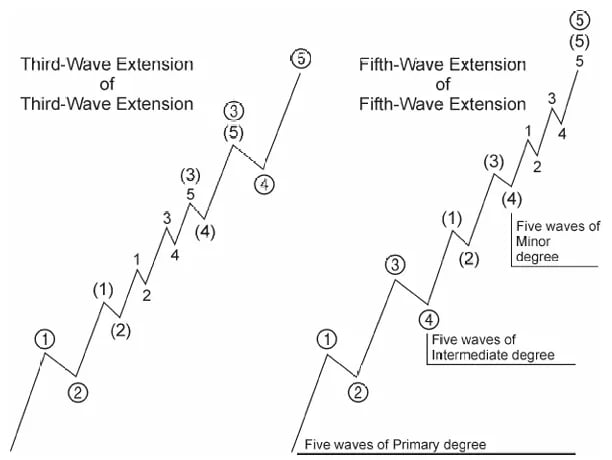
Extensions Within Extensions
Elliott Wave is fractal. When an extension occurs at one degree, it often repeats internally at smaller degrees.
For example:
An extended wave 3 may also contain an extended subwave 3
Momentum tends to reinforce itself rather than distribute evenly
This repetition explains why strong trends often feel relentless once established.
Recognising Extensions Through Preceding Corrections
Extensions are often foreshadowed by the character of the prior correction.
Common tendencies include:
Shallow retracements rather than deep pullbacks
Preceding corrections exhibit the same pattern (two flats or two zigzags in a row)
Fast, directional corrections instead of sideways movement
Limited overlap and minimal consolidation
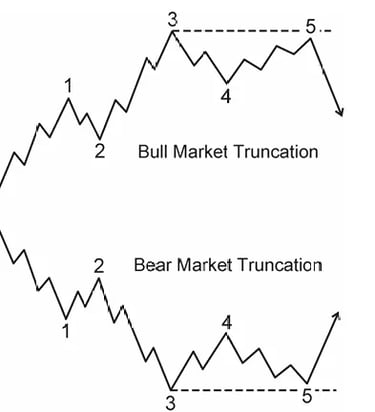
What Is a Truncated Fifth Wave?
A truncation occurs when wave 5 fails to exceed the end of wave 3.
Despite completing internally as a five-wave structure, price lacks the strength to produce a new extreme. This failure is a strong signal that trend momentum has been exhausted.
Truncations are not structural errors — they are informational signals.
Conditions That Often Precede Truncations
Truncations tend to appear after:
An unusually strong or extended wave 3
A relatively shallow wave 4 correction
Diminishing momentum during wave 5
The market attempts continuation but cannot sustain it.
Why Truncations Matter
Truncated fifth waves are frequently followed by:
Sharp reversals
Fast corrective moves
Larger-degree trend changes
They act as early warnings that the dominant trend has lost participation.
How Extensions and Truncations Improve Decision-Making
Together, these concepts help traders:
Identify where momentum is concentrated
Avoid assuming symmetry where none exists
Adjust expectations as structure evolves
Recognise exhaustion before reversals accelerate
Not all waves deserve equal confidence. Extensions reveal strength; truncations reveal fatigue.
How This Lesson Fits the Series
This lesson explains how impulse waves distribute momentum unevenly and why trends sometimes end abruptly rather than cleanly.
The next lesson builds directly on this idea by introducing diagonal waves, where overlap and weakening structure signal final pushes and major turning points.
Elliott Wave Trading Course Series
This article is part of the Elliott Wave Trading Course.
Lessons in this series:
Part 2: The Simple Market Structure That Explains Every Price Move
Part 3: Why Elliott Wave Provides More Context Than Traditional Indicators
Part 4: The Elliott Wave Phases That Offer the Clearest Trading Opportunities
Part 5: Elliott Wave Extensions and Truncations
Part 7: Corrective Wave Structures and Fibonacci Relationships in Elliott Wave
Part 8: Applying Elliott Wave Structure with Confirmation-Based Trade Execution
Part 9: Risk Management and Psychology
Disclaimer:
Trading forex involves significant risk and may not be suitable for all investors. Past performance is not indicative of future results. The information and signals provided on this website are for educational purposes only and should not be considered financial advice. You are solely responsible for your trading decisions and any resulting financial losses. Please consult with a licensed financial advisor before engaging in forex trading.
© 2026. All rights reserved.
Trading Resources: [Market Insights] [Elliott Wave Course] [Forex Signals Guide] Tools: [Economic Calendar ][Position Size Calculator] Support: [FAQ] [Contact] [New To Telegram?]