Free 14-Day Access ON TELEGRAM

Part 1: Why Elliott Wave Fails Most Traders — and How to Use It Properly
Many traders discover Elliott Wave because they want clarity. They learn to label charts accurately, recognise patterns, and anticipate future movement — yet still struggle to translate that analysis into consistent results. The reason is simple: strong analysis does not automatically lead to strong trading decisions. Elliott Wave is a powerful observational framework, but profitability depends on how that framework is applied under real market pressure.
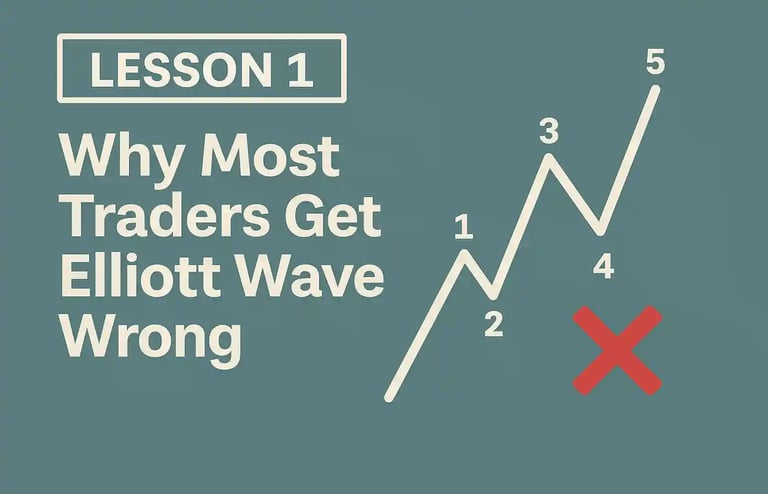
Analysis Skill and Trading Skill Are Not the Same
Learning to identify wave structure develops analytical skill. Trading profitably requires something different — discipline, restraint, and self-management.
Many traders experience the same pattern:
Clean wave counts
Logical expectations
Poor execution under uncertainty
The market does not reward accuracy alone. It rewards decision-making.
There Is No Universal “Correct” Way to Trade Elliott Wave
Elliott Wave does not prescribe a single trading style.
Each trader operates with different:
Risk tolerance
Account size
Time availability
Market focus
For this reason, Elliott Wave works best as a guiding framework, not a rigid rulebook. The guidelines that follow throughout this series are designed to support decision-making, not replace it.
The Most Important Question to Ask First
Before entries, exits, or targets are considered, one question matters more than all others:
Do I clearly recognise the structure I am looking at?
Many traders skip this step and attempt to trade uncertainty. Elliott Wave reduces complexity by limiting market structure to a small number of repeatable patterns.
At a high level, all Elliott Wave analysis is built from five core structures:
Impulse waves
Diagonal waves
Zigzags
Flats
Triangles
If price does not resemble one of these structures, patience is often the best position.
Simplifying Elliott Wave Even Further
For traders still developing confidence, Elliott Wave can be simplified to a single distinction:
Is the market moving with the trend, or against it?
This divides price action into two broad categories:
Motive waves, which move in the direction of the dominant trend
Corrective waves, which temporarily move against it
Motive waves include impulses and diagonals.
Corrective waves include zigzags, flats, and triangles.
Being able to identify whether price is trending or correcting already places a trader ahead of those treating market movement as random.
Why This Perspective Changes Everything
Elliott Wave is not about prediction. It is about context.
When traders understand whether price is expanding or correcting, they:
Reduce emotional reactions
Avoid forcing trades
Align expectations with structure
Structure replaces guesswork.
What This Series Is Designed to Build
This series develops Elliott Wave from the ground up — not as a chart-labeling exercise, but as a decision-making framework.
Across the lessons ahead, you’ll learn:
How market structure unfolds
Which phases consistently offer the clearest opportunities
How momentum concentrates and fades
Why risk management and psychology matter as much as analysis
How to combine structure into a complete trading framework
Markets will test analytical understanding, but they test emotional discipline even more.
Where This Journey Begins
This lesson establishes the mindset required to use Elliott Wave effectively. It is not about perfection — it is about clarity, patience, and structure.
The next lesson introduces the simple market pattern that explains all price movement, forming the foundation for everything that follows.
Elliott Wave Trading Course Series
This article is part of the Elliott Wave Trading Course.
Lessons in this series:
Part 1: Why Elliott Wave Fails Most Traders
Part 2: The Simple Market Structure That Explains Every Price Move
Part 3: Why Elliott Wave Provides More Context Than Traditional Indicators
Part 4: The Elliott Wave Phases That Offer the Clearest Trading Opportunities
Part 7: Corrective Wave Structures and Fibonacci Relationships in Elliott Wave
Part 8: Applying Elliott Wave Structure with Confirmation-Based Trade Execution
Part 9: Risk Management and Psychology
Disclaimer:
Trading forex involves significant risk and may not be suitable for all investors. Past performance is not indicative of future results. The information and signals provided on this website are for educational purposes only and should not be considered financial advice. You are solely responsible for your trading decisions and any resulting financial losses. Please consult with a licensed financial advisor before engaging in forex trading.
© 2026. All rights reserved.
Trading Resources: [Market Insights] [Elliott Wave Course] [Forex Signals Guide] Tools: [Economic Calendar ][Position Size Calculator] Support: [FAQ] [Contact] [New To Telegram?]